Integration Methods by Rendering Type
Web applications and websites have several types of rendering methods for their HTML.
In particular, modern web application frameworks like Next.js allow for control over the rendering method on a per-page basis.
In this environment surrounding web frontend development, it is important to understand the advantages and disadvantages of each rendering method and choose the one that fits the nature of the page.
This page will explain the overview, advantages, and disadvantages of each rendering method, as well as how to integrate them when using microCMS.
Information
The sample code is an implementation example using Next.js (Pages Router).
List of Rendering Methods
CSR (Client Side Rendering)
CSR is a method of dynamically generating web pages using JavaScript.
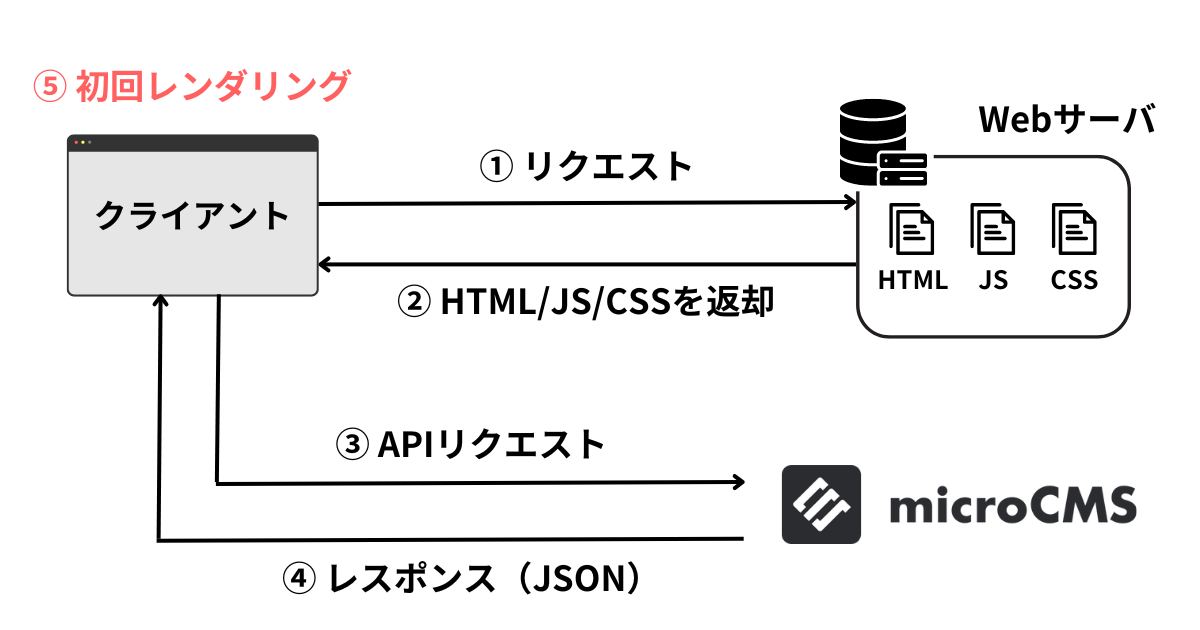
In CSR, an empty HTML file, CSS, and JavaScript are first retrieved from the server. Then, initial data is fetched from an API server (or a headless CMS like microCMS), and the HTML is rendered.

Advantages
- Can update data in real-time based on user UI interactions
- Easy to integrate into sites operating as static HTML
- Can be partially integrated into already built applications
Disadvantages
- Since data is fetched after loading static files, the initial display is fast, but data display may be slow.
- May negatively impact SEO (search engine crawlers may not accurately recognize the content).
- It can be difficult to display OGP accurately.
- May not display correctly for users who have disabled JavaScript in their browsers.
- API keys cannot be kept secret (however, this can sometimes be avoided by accessing through the server side).
Cases Suitable for CSR
- Web applications with rich UI interactions and animations
- Applications providing content that is not important for SEO or requires login for private content
Implementation Example
import { useEffect, useState } from 'react';
import { createClient } from 'microcms-js-sdk';
const client = createClient({
serviceDomain: 'YOUR_DOMAIN',
apiKey: 'YOUR_API_KEY',
});
const Announcements = () => {
const [announcements, setAnnouncements] = useState([]);
useEffect(() => {
const getAnnouncements = async () => {
const data = await client.get({ endpoint: 'announcements' });
setAnnouncements(data.contents);
};
getAnnouncements();
}, []);
return (
<div>
{announcements.map((announcement) => (
<div key={announcement.id}>
<h2>{announcement.title}</h2>
<p>{announcement.content}</p>
</div>
))}
</div>
);
};
export default Announcements;SSR (Server Side Rendering)
SSR is a method of generating HTML on the server side.
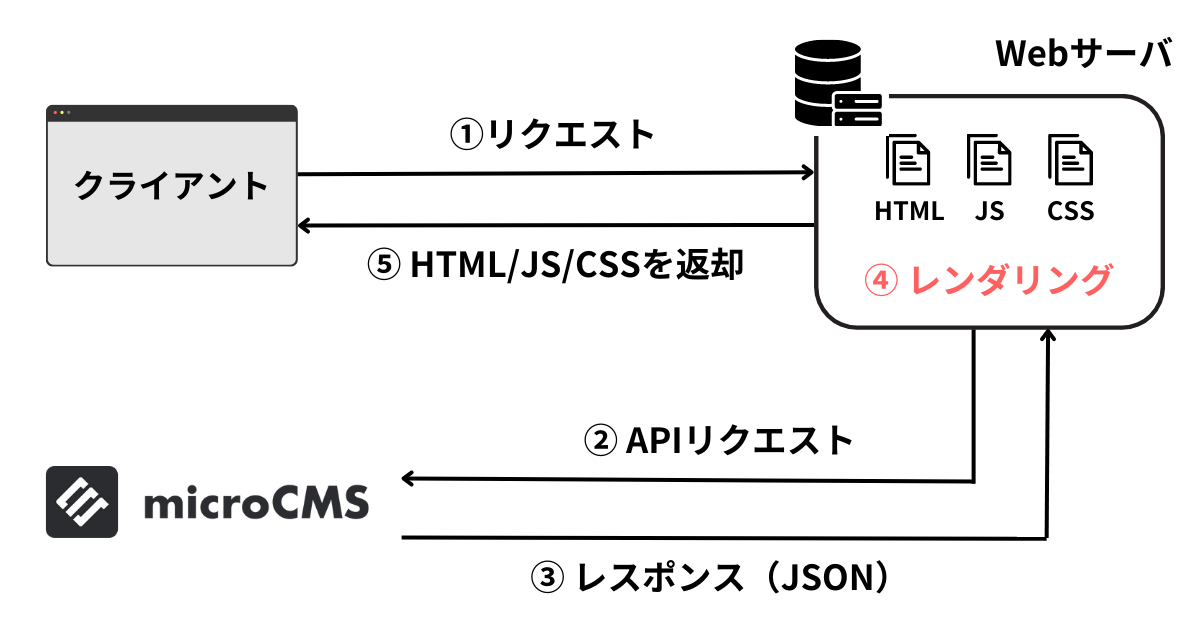
When the server receives a request from the client, it retrieves the necessary content through API requests and then generates HTML to return to the client.
The client receives the rendered HTML, loads the CSS and JavaScript, and displays the page.
This method contrasts with CSR, where HTML is generated on the client side.

Advantages
- HTML is generated for each request, allowing for dynamic elements on a per-page basis.
- Since HTML is generated on the server and sent to the client, there is no lag in displaying dynamic data.
- As HTML is fully generated on the server, crawlers can easily understand the content, making it effective for SEO.
- Processing is done on the server, reducing the load on the client side, which helps maintain performance even on low-spec devices or slow internet connections.
Disadvantages
- Since HTML needs to be generated for each request, it can lead to a high load on the server, and scaling may be necessary in case of high traffic.
When SSR is Suitable
- Websites with dynamic elements that require SEO optimization.
Implementation Example
import { createClient } from 'microcms-js-sdk';
const client = createClient({
serviceDomain: 'YOUR_DOMAIN',
apiKey: 'YOUR_API_KEY',
});
export const getServerSideProps = async () => {
const data = await client.get({ endpoint: 'announcements' });
return {
props: {
announcements: data.contents,
},
};
};
const Announcements = ({ announcements }) => {
return (
<div>
{announcements.map((announcement) => (
<div key={announcement.id}>
<h2>{announcement.title}</h2>
<p>{announcement.content}</p>
</div>
))}
</div>
);
};
export default Announcements;SSG (Static Site Generation)
SSG is a method of generating static HTML in advance.
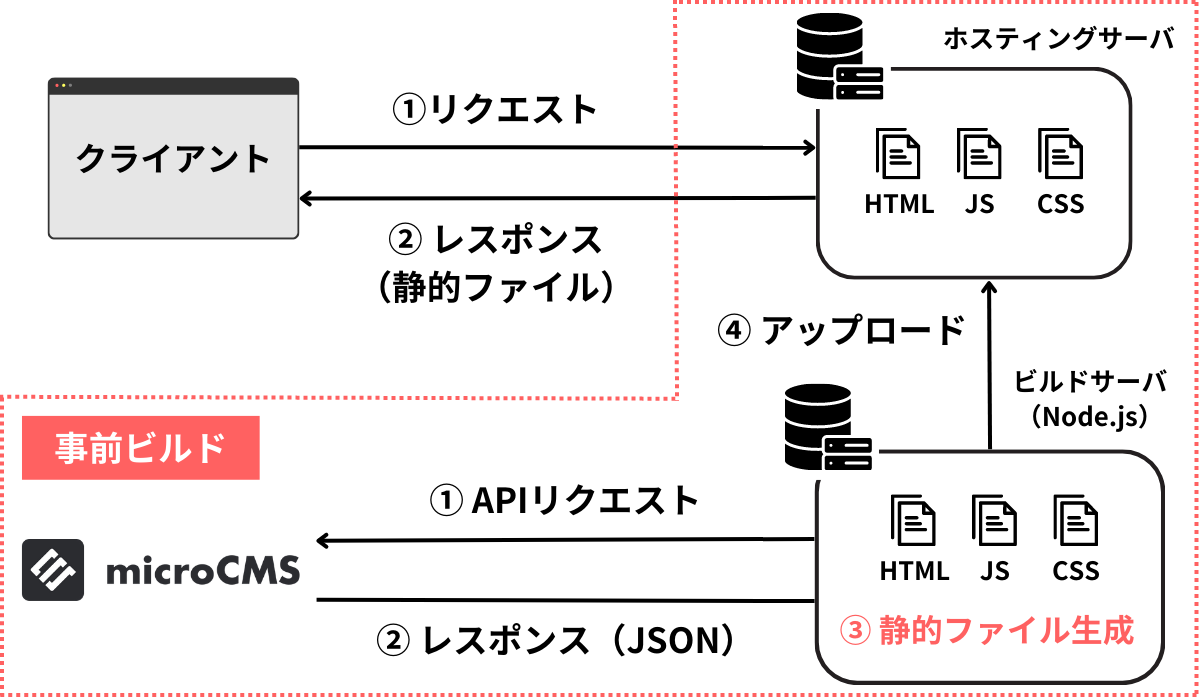
In SSG, when content or templates are updated, the build process is executed to pre-generate all pages. These static files are then deployed to a hosting server to respond to client requests.
To leverage the characteristics of SSG, it is common to place and distribute them via a CDN.

Advantages
- Using static files results in a faster response time from the server to the client, improving the performance of the website.
- Since deployment can be done simply by generating static files, it is easy to deploy and lowers the demands on the server.
Disadvantages
- If the site has many pages, build times can become long to generate all pages.
- Updating content requires a build process, making real-time data updates difficult (however, some data can be dynamically fetched on the client side).
- Using static files limits the implementation of user authentication and dynamic features (however, dynamic features can be achieved on the client side using JavaScript or APIs).
When SSG is Suitable
- Websites with a lot of static content that do not require real-time updates (such as corporate sites or blogs).
Implementation Example
import { createClient } from 'microcms-js-sdk';
const client = createClient({
serviceDomain: 'YOUR_DOMAIN',
apiKey: 'YOUR_API_KEY',
});
export const getStaticProps = async () => {
const data = await client.get({ endpoint: 'announcements' });
return {
props: {
announcements: data.contents,
},
};
};
const Announcements = ({ announcements }) => {
return (
<div>
{announcements.map((announcement) => (
<div key={announcement.id}>
<h2>{announcement.title}</h2>
<p>{announcement.content}</p>
</div>
))}
</div>
);
};
export default Announcements;ISR (Incremental Static Regeneration)
ISR is a hybrid rendering method that combines the features of SSG and SSR.
In ISR, instead of pre-building the entire site like SSG, only the necessary pages are generated at the required time. The generated pages are cached and served as static content for subsequent requests.
Additionally, a validity period can be specified for the cache, and if access occurs after the validity period has expired, the page will be regenerated. This mechanism allows for the provision of relatively fresh content.
Currently, ISR is supported by some frameworks, such as Next.js.
Advantages
- Since the generated pages are cached, they can be served quickly on subsequent accesses.
- There is no need to generate all pages at the time of content publication, which can significantly reduce build time.
- Pages are regenerated at specified intervals, allowing for support for frequently updated content.
Disadvantages
- Since pages are generated on demand during the first access, there is a possibility that the display speed may be slower at that time.
- Pages are only regenerated at the specified intervals, which may impose limitations when real-time updates are needed.
- The frameworks and infrastructure available for use are limited.
Use Cases for ISR
- Large websites where building all pages takes a significant amount of time.
- Websites with frequently updated content.
Implementation Example
import { createClient } from 'microcms-js-sdk';
const client = createClient({
serviceDomain: 'YOUR_DOMAIN',
apiKey: 'YOUR_API_KEY',
});
export const getStaticPaths = async () => {
const data = await client.get({ endpoint: 'announcements' });
const paths = data.contents.map((announcement) => ({
params: { id: announcement.id.toString() },
}));
return {
paths,
fallback: true,
};
};
export const getStaticProps = async ({ params }) => {
const data = await client.get({ endpoint: `announcements/${params.id}` });
return {
props: {
announcement: data,
},
revalidate: 10,
};
};
const Announcement = ({ announcement }) => {
return (
<div>
<h2>{announcement.title}</h2>
<p>{announcement.content}</p>
</div>
);
};
export default Announcement;